

Our Many Bodies, Against Alienation
Posthumanism in the work of contemporary South Asian artists
We are at a precipice. We’ve been teetering here for some time now—markedly since 2020’s Covid-19 pandemic toppled state infrastructures and delusions of safety nets in the Global South; more recently since the aftermath of October 7, 2023, when the notions of a just international order were dismantled altogether.
In his essay on the transformation of Bombay to Mumbai in art, Mustansir Dalvi describes how liberalisation in the early nineties, subsequent deregulation and industrial production led to a rise in India’s GDP and consumerist imperative. In urban centres like Bombay India’s post-independence ethos shifted from civic engagement towards foregrounding individual aspiration. Redevelopment over repair transforms Bombay’s history of state-provided affordable housing towards Mumbai’s luxury market.
The ubiquitous builder-apartments replacing older houses are the perfect symbol for the transition of Indian cities from “slow, intimate and idiosyncratic” to “fast, vast and generic”, as Rana Dasgupta writes in Capital. In prosperity, the tendency of South Asia has been to grow insular. Consider Gurugram, where the Camellias are one of many self-contained luxury residential projects whose bubble one need never leave. Or Dhaka, where Hatirjheel park, one of the only remaining green spaces in the city, was eaten by an elevated expressway. In this moment of ecological and social fragmentation, South Asian artists have begun to respond. Their work often has a recurring image: a small human figure dwarfed by mechanical monsters of man’s own making.
We can trace these shifts in art like movements in a musical composition: Lament and Dissolution. Laments mourn the eroding world, while Dissolution inches us into embracing an already existing posthuman paradigm.
Movement 1: Lament
The first movement is defined by the observation of loss. Artist Sudhir Patwardhan, who arrived in Bombay in the 1970s, witnessed the first major reclamation of land from the sea, workers’ movements in the 1980s, and the rapidly changing infrastructure of the city. In 2025, his show ‘Cities Built and Broken’ reflected the aftermath of the past decades—the daily crush of life in Mumbai. In his paintings, we see everyman walkers dwarfed by mammoth footbridges on their way to catch the local train, a desolation of craters, construction sites where old buildings have been torn down for new builder-apartments. Similar laments can be seen in the work of Meera Devidayal whose office-windows provide reflections of the sea but not the sea itself, or in Parag Tandel’s funeral mourning the bombil fish.
Movement 2: Dissolution
While the first movement mourns the distance between man and nature, the second movement, the posthuman turn, dissolves that boundary entirely. This is where the work of Shailee Mehta begins. Mehta sees bodies, like landscapes, as sites that ‘rupture, scab, shed, bleed, bruise, produce’—imitating the trees and lands that they interact with.
She draws bodies like trees or free-hand lines—bare, asymmetrical and gestural— building on a miniaturist figurative tradition, to present ‘exaggerated forms’. We see this vividly in A Perfect Nonplus.
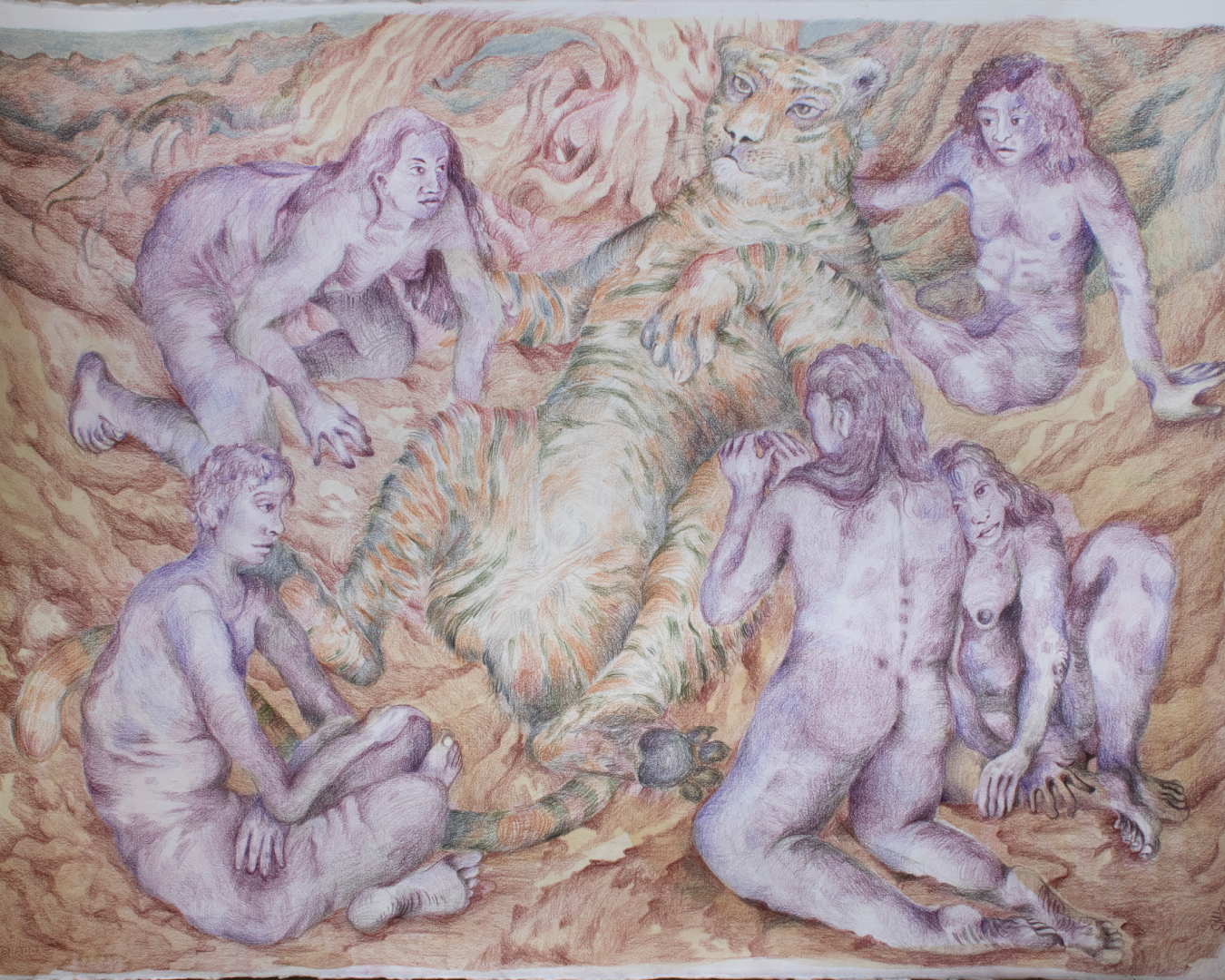
The soft female bodies look almost like worms. A woman with hair cropped short sits at the feet of a benevolent tiger who exposes its zucchini-striped belly (trust!). Her limbs taper like root-tubers, lumpy and bumpy, one among a pile of periwinkle people. The woman at the bottom right of the frame—with her feet arched, her breast hanging above her bulbous tummy—doesn’t titillate; she is a creature among creatures. We see a breathing network of limbs enmeshed at the feet of a mangrove.
This imagery evokes Donna Haraway’s Companion Species Manifesto, which argues that beings do not preexist their relatings. There are no airtight, pre-formed subjects and objects, only an active process of becoming.
Haraway writes, ‘the relation is the smallest unit of analysis’. Mangrove forests, which are among the most productive and biologically complex ecosystems on earth, exemplify this relational model of the world.
Mehta first encountered them in Goa’s Salim Ali Bird Sanctuary. “We could just hear water drops falling into the swamp and distant bird sounds. [We were] surrounded by shadows of very bodily trees with wobbly fingers,” she recalls. Struck by how the trees were red like flesh under their brown bark, she began reading about them. Mangroves, which control water regulation, survive in saline water, and prevent flooding, have been under extreme duress by land reclamation projects and industry in Mumbai and Goa where she lives. Vivipary—their unusual mode of reproduction in which seedlings stay attached to the parent till germination, also felt distinctly mammalian to Mehta.
This overlap between human, animal, and plant categories radiates through ‘A Perfect Nonplus’. It’s a generative confusion, the lilac bodies are mammalian—like women, like mangroves, like companion species. Here we have the second movement, another shift: dissolution.
This lens of dissolution is described in material ecocriticism, a framework theorized by Serenella Iovino and Serpil Oppermann. Material ecocriticism builds on ways of seeing that “extend the category of agency beyond the realm of the human, demonstrating the kinship between out-side and in-side, the mind and the world, embracing life, language, mind and sensorial perception in a non-dualistic perspective”. I find it a rich and instructive framework through which to read the works of artists who transgress the strict boundaries between human and nonhuman.
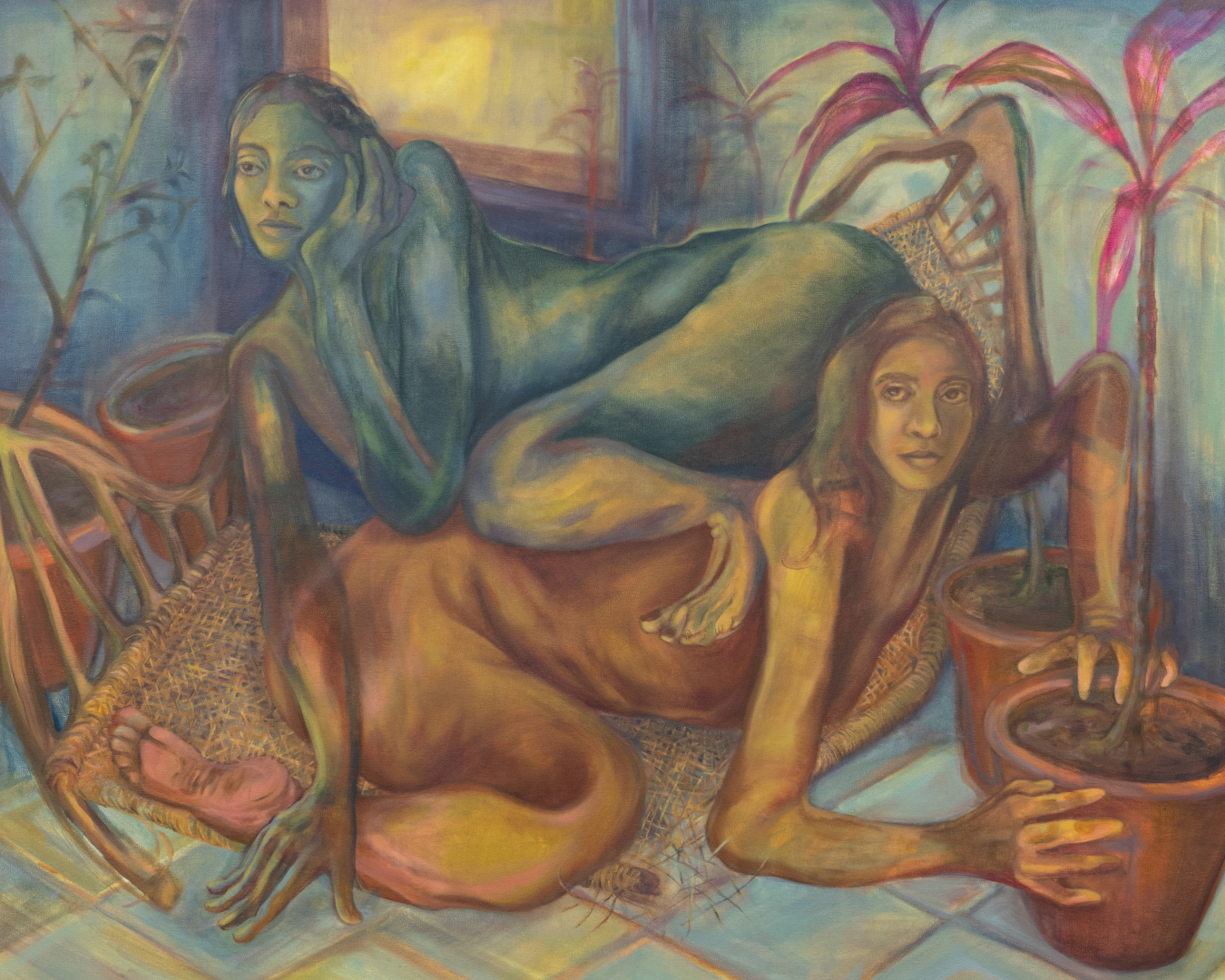
In Mehta’s Twin(e) we see the languid wide open eyes of a lizard, a feline stance in the arrangement of two women. At any moment, a tongue might flicker, one might relieve herself on a potted plant. There’s something inscrutable about their gazes: one bored looking off, and the other, combative. The animating force is ungovernability.
Mehta’s use of animalistic poses and abandon blur the boundaries between human and animal, appropriate and taboo behaviour. Her fluid earthy tones make this way of seeing compelling. The green-yellow torso could well be the trunk of a tree; the reddening sole of a foot under pressure is the colour of alta or a root vegetable. As they stretch, so does our conception of human/animal or human as animal. Even if we have taxonomised and named ourselves sovereign, there’s an elasticity in the range of human behaviours that is hard to shake off. This becomes more visible in heightened states—pain, orgasm or the polar ends of life: infancy and infirmity.
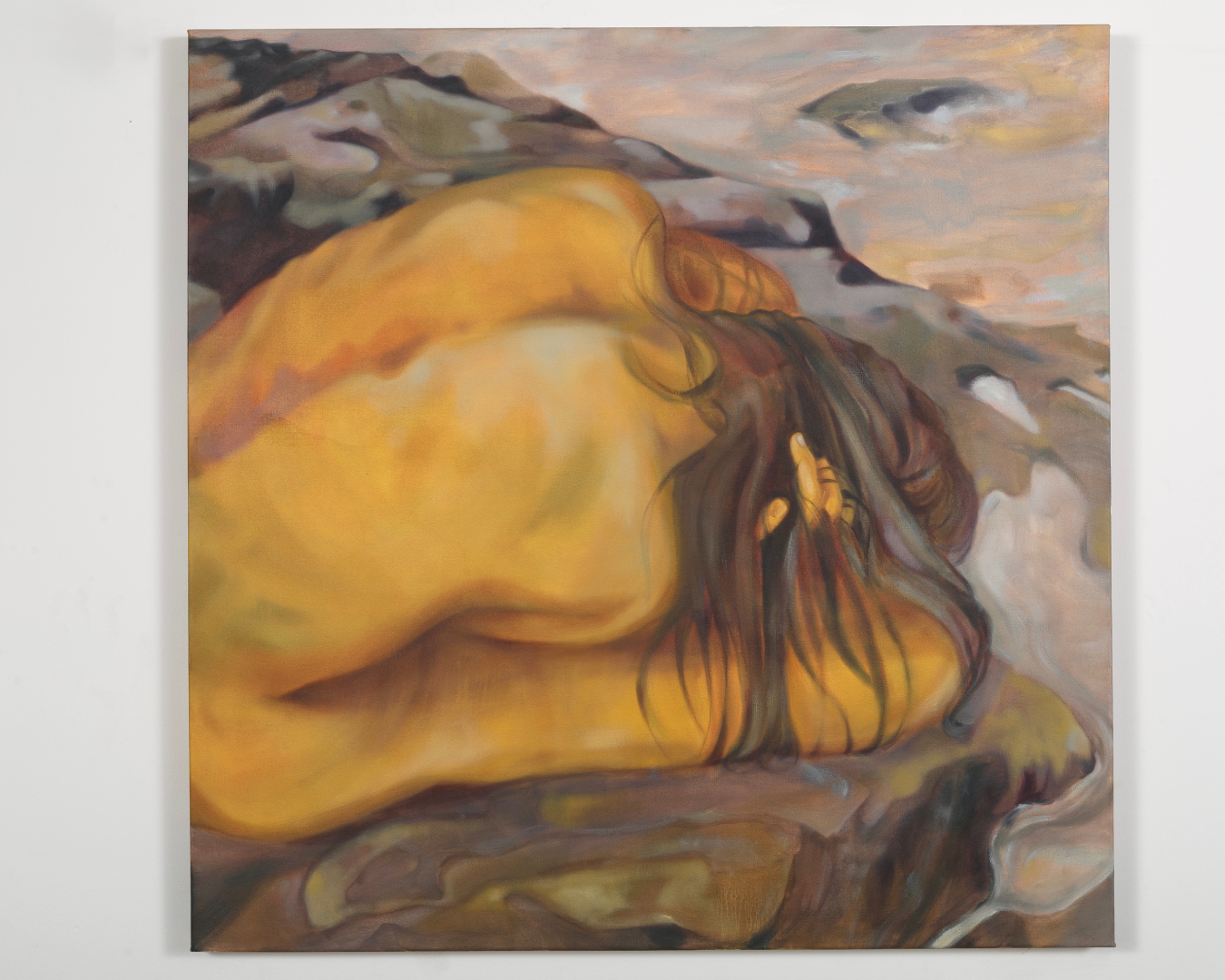
In ‘Under the afternoon sun’ jackfruit flesh ripens, hair streams like seaweed or algal bloom. It’s easy to imagine plunging your fingers into the ripe middle and cracking the fruit open, sweet and juicy. Imagine this body as shale or some kind of pearlescent marine rock-formation. Imagine the oily prepubescent body massaged and held by the ghost hands of aunties and mothers in childhood. As Karen Barad writes, “We do not obtain knowledge by standing outside of the world; we know because ‘we’ are of the world. We are part of the world in its differential becoming”.
Berlin-based artist Sajan Mani echoes this sentiment: “Fundamentally I believe we are also part of nature. It is a Western idea that differentiates these two.” Born to a family of rubber-tappers in Kannur, Mani uses rubber both as medium and subject of inquiry.
For his show ‘Multiple Legs of a Historically Wing-Chopped Bird’ (2025), he mined artefacts that subjugated Dalit histories like the first Malayalam-to-English dictionary, photographs and records of labourers made by colonists—to reveal them instead. Mani is interested in what or who counts as human and not human, animal or not animal — a question made urgent by how caste structures reality in South Asia.
The kids looked up to the high heavens and cried
Nobody for us, they wept
Then they saw a Pariah Kite soaring high up in the sky
…
Mani’s show derives its title from a song by the poet-revolutionary, Poykayil Appachan, a larger-than-life, counter-god figure of the Kerala Renaissance. In the song, children wander the forest searching for their parents who have been sold as slaves to different owners. A pariah kite comes down to address them, singing of grandparents labouring in the rice-fields, tied to the plough with animals and injured. In performing the song Mani says, “I was also becoming a beast — a cow”.
The show begins where the song ends; the rubber works, video-installation, and the tongue represent the different legs of the pariah kite. ‘Pariah’ — a word historically used to denigrate Dalit people — is repurposed by Appachan and Mani continues this tradition.
This tension carries through his work with rubber. Brought to Kerala from the Kew Gardens in the 20th century, its loaded bloody history is inextricable from the nostalgia of his childhood memories helping his parents in the plantation. “When you take the milk from this tree you will always get another layer of skin on your hands. So at the end of the day, you have to remove this very smelly, second skin from your hands. We also used to make different things from it—dolls and so on,” he remembers.
For Sajan Mani, rubber in its stretchiness and smelliness, is a material that blurs lines between human, animal, and nonhuman. In ‘Stretched light and muted howls’ Mani transferred archival photographs of the labourers onto rubber, enabling a kind of “gazing back” across time. “Sometimes I feel like my body is also very fluid and it spills over. And it tries to stretch. We are also multiple inside,” he says. “I wonder, is my body a vessel for all the ions and other beings that live inside of us, or is it the other way around?”
Material ecocriticism suggests that human agency and meanings are deeply interlaced with the emerging agency and meaning of nonhuman beings like water, soil, stones, metals, minerals, bacteria, toxins, food, electricity, cells, atoms, all cultural objects and places. The latter are inextricably connected to our lives, and part of our bodies—our “material self.” (Iovino and Oppermann, 83).
Consider our bodies as collectives, assemblages with leakiness between insides and outsides. This final movement of this posthuman symphony brings us to Dhaka-based photographer Sarker Protick. In ‘Akash Kalo Megh’, Protick chronicles the rapidly developing city, his mother’s house, and the crows who fly across both, making meaning of it all.
His film follows his mother through her day in her flat, coming to a crescendo with a downpour in which we see a mirroring between the crows she feeds, and herself. The strict boundaries humans have erected — the frames of buildings, between man and nature — are dissolved by rain. His mothers eyelashes wet with rain transmute into the shuddering of crow-wing feathers. This is trans-corporeality (movement between bodies) in motion.
With this movement we step firmly into an interactionist ontology, a term coined by Nancy Tuana, referring to the relational nature of being. Here we see the ‘social’ (humanness and being) as material once again, and take seriously the agency of the natural (nonhuman) that surrounds us (85).
Against anthropomorphism, towards a material ethics
The work of Mehta, Mani, and Protick represents an ecomaterialist turn in South Asian art. With their sensibility of material ecocriticism, their works stress the agentic power of matter, and the horizontality of its elements. I see their work in dialogue with each other, sharing affinities for the dissolution of boundaries and hierarchies. They contribute to a burgeoning shared cultural and moral imaginary, and a broadening of perspectives that replaces the oppositional forces of dualism with a continuum ofintra-actions.One that is animist, posthuman, and liberatory in ethos.
With this ecomaterialist turn in South Asian art, I believe we have entered a tremendously rich space. In Sarker Protick’s crows, the liminal animals of our cities, there are myriad possibilities for developing concepts like co-citizenship with animals as Sue Donaldson and Will Kymlicka outline inZoopolis. Such concepts built on interdependencies from the disability-justice movement, are perhaps not so radical. As a response to the catastrophes of late-capitalism, we can pause here, like Sudhir Patwardhan’s commuter, even as we hurtle into a future. Here is the fertile ground upon which a new South Asian imaginary is being built—one that is posthuman (non-extractive, anticaste, postcolonial) and in which kinship replaces consumption.
Notes
- Drawing from a variety of conceptual references including Greek atomism and Renaissance philosophy to the work of Merleau-Ponty, Bruno Latour, Donna Haraway, as well as Actor-Network theory, agential realism and object oriented ontology.
- Karen Barad develops the concept of intra-action in contrast with that of interactions which “presumes the prior existence of independent entities/relata” (Loc. 2405). Intra-action means a process through which “the boundaries and properties of the ‘components’ of phenomena become determinate and […] particular embodied concepts become meaningful” (Loc. 2405-27). This implies that the traditional Cartesian divide between subject and object does not exist prior to the establishment of these relations or intra-actions since both are part of the same material continuum, which is organized through these intra-actions.
 SIGN IN WITH GOOGLE
