

On Refusing to Separate Art from Institutions
Through two case studies of structural injustice in the Indian art world, this essay challenges art criticism that ignores institutional contexts and calls for a writing practice that accounts for labor conditions and systemic power.
By Neha Limani
Art writing and criticism have carved an important space in the arts. Whether through exhibition reviews, theoretical essays, or academic papers, writing about art comes in different forms and styles. Yet in Indian contemporary art, marked by caste, class, gender discrimination, and workplace abuse, and structural exclusion, it is no longer enough to engage with works on a purely formal basis. Following Michael Schreyach, criticism should be addressed to a public rather than only to specialists and should reflect a real confrontation between writer and work, not just technical evaluation. For Matthew Bowman, art criticism is also a collaborative practice that shapes communities around art. Combined with Daniel Neofetou’s insistence that political art criticism must address the conditions it names rather than neutralise them, these positions frame my question: what role can art writing play when the art itself is produced and circulated by compromised institutions?
Through analysing two events—Anita Dube’s use of Aamir Aziz’s anti‑CAA poem without his prior knowledge and #MeToo‑related allegations against the co-founder of the Kochi‑Muziris Biennale, this essay examines how exhibitions, biennales, and art fairs frame works tied to marginalised communities and politics while remaining sites of contestation. It argues for a form of art writing that refuses to separate artworks from the institutions and labour conditions that make them possible. Instead, it proposes modes of writing that hold artworks, institutional violence, and conditions of labour in the same frame, refusing to let criticism function as a tool of reputational laundering.
Poet, Artist and ‘Ethical Lapse’
On April 20th, 2025, poet Amir Aziz, through social media posts, accused artist Anita Dube of using his internationally acclaimed poem “Sab Yaad Rakha Jayega” in works for the exhibition titled Three Storey House at Vadhera Art Gallery without his knowledge and consent1. The poem had its own life, and the way Dube embroidered it on velvet cloth and placed it in a gallery space for commercial purposes was not ideal, according to Aziz. Statements were given by both the gallery and the artist describing it as an “unintentional mistake” and an ethical lapse2, a framing that risks turning a structural pattern of extraction into a one‑off moral oversight (McCartney 2022). The controversy ended on the same platform when, in August, 2025 Aziz posted on his Instagram that the gallery had resolved his concerns.
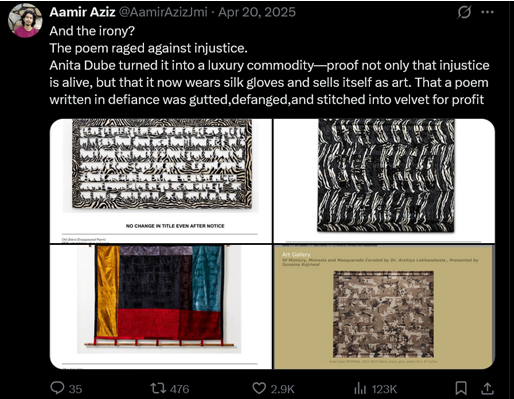
Figure 1. Screenshot of a tweet by Aamir Aziz (@AamirAzizJmi) about Anita Dube’s use of his poem “Sab Yaad Rakha Jayega”, posted on 20 April 2025.2
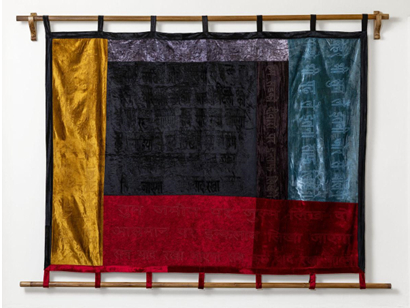
The fire died down. People moved on. Benefitting from the social popularity of the themes of ‘Dada’ and ‘Animal farm’4, the exhibition note wants to access the political weightage of these words without actually practicing them. As Neofetou notes, political art criticism that restricts itself to formal or thematic analysis tends to dissolve the particularities of how works are produced and circulated, turning politics into content rather than relation (Neofetou 2021). When dealing with artworks which are termed ‘political’, we often feel the violence is always what the piece is talking about and not what it itself has been perpetuating. The usage of Aziz’s poem without giving him the credit was an issue, but the material of the artworks and the space they were displayed in were for a certain class and not for the marginalised for whom Aziz writes (Bhasthi 2025). This is not an isolated tension. Writing on Dalit art in Indian exhibitions, Aarushi Punia shows how institutions often celebrate “marginalised” work while quietly stripping it of its political and caste‑marked force, keeping structural hierarchies intact (Punia 2025). The questions asked by him should belong in the criticism of an exhibition reviewer. By not addressing these issues, the writer and the publications both become irrelevant in the larger scheme of art world. From the captions of the artworks to the gallery’s response, every layer worked as a gateway into a system well known for representing marginalised voices while excluding them structurally. To understand that system, we cannot look at artwork, artist and institution separately; criticism has to hold them together if it wants to engage incidents like this critically.
“Me Too” at the Biennale
In January this year, Bose Krishnamachari, co-founder of the Kochi-Muziris Biennale, resigned from his roles as president and member of the board of trustees of the Kochi Biennale Foundation (KBF)5. It later emerged that his resignation came in light of a sexual harassment complaint filed against him by one of the female employees6. This was not the first time the biennale had faced such allegations: in 2018, another co‑founder, Riyas Komu, stepped down from all organisational roles after accusations of sexual misconduct during the #MeToo moment7. The repetition is telling. An institution celebrated for progressive programming and public discourse around rights has, more than once, had to reckon with allegations of gendered violence from within its own workforce. Writing on the scale and significance of “India’s first and only biennale”, some coverage mentions these allegations only in passing, folded into a celebratory narrative of the institution8. McCartney shows how institutions often sustain the fiction that art and artists can be separated, even while relying on progressive rhetoric about rights and representation (McCartney 2022). In Kochi’s case, public programming around women’s rights sat uneasily alongside allegations by women workers within the same institution.
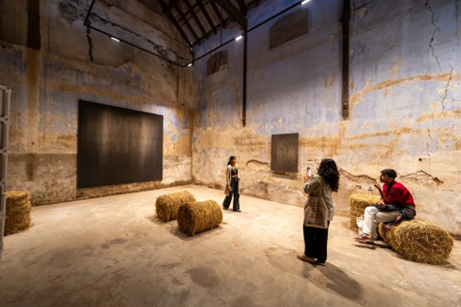
As Federica Arcoraci notes, contemporary museums and biennales operate through an integration–exclusion dialectic: they integrate certain critical or marginal discourses as cultural content while excluding the very subjects and workers whose lives those discourses concern (Arcoraci 2024). In such a context, art writing that only offers formal analysis or institutional praise is not neutral; it actively participates in that integration–exclusion logic by leaving readers unaware of the labour conditions that make the art possible. Do we want our readers to remain unbothered and unaware of these conditions, and in doing so become irrelevant or do we write the complexities and let them navigate artworks, artists and institutions together?
Art writing must refuse to separate artworks from the institutions and labour conditions that make them possible. Following Mikkel Bolt Rasmussen, institutional critique works with art’s relative autonomy not to escape institutions but to expose and transform their operations from within (Rasmussen 2017). For criticism, such an approach means refusing to deprive readers of knowledge about artists’ backgrounds or institutions’ exploitative histories. Painting a fuller picture helps us understand complex histories; if an artwork cannot bear that understanding, it was never great from the start (McCartney 2022). Our encounters with artworks should not be organised around isolation but around knowledge of the systems that shape them. Just paraphrasing wall texts is not art writing. As Schreyach reminds us, criticism must reflect the writer’s confrontation with the object in ways that serve the public. The Dube–Aziz and Kochi cases show how deeply the system depends on exploitation; we need criticism that keeps these entanglements visible and that stops pretending artworks are innocent when their conditions of production are not.
Footnotes:
- https://theprint.in/feature/artist-anita-dube-uses-caa-protest-poem-in-artwork-poet-aamir-aziz-says-its-plunder/2597751/
- https://www.facebook.com/dube.anita/posts/pfbid02eaqWNj2kZWAsvSU4yYTVuKEcGEvqBuqi4qCVDF4M9sWHXLvhu2Seg39z9iQPCzyyl
- https://www.instagram.com/p/DN0I8YmWmXb/?hl=en
- Vadehra Art Gallery, “Anita Dube: Three Storey House,” exhibition page, accessed 17 June 2026,https://www.vadehraart.com/exhibitions/251/works/images6025/
- https://www.vadehraart.com/exhibitions/251-anita-dube-three-storey-house-d-53-defence-colony-new-delhi/overview/
- https://artreview.com/bose-krishnamachari-resigns-from-kochi-biennale-foundation/
- https://artreview.com/bose-krishnamacharis-resignation-from-kochi-biennale-came-after-sexual-harassment-allegations/
- https://thewire.in/women/riays-komu-kochi-biennale-me-too
- https://www.artbasel.com/stories/kerala-kochi-muziris-biennale-foundation?lang=en
- “The Sixth Kochi-Muziris Biennale Foregrounds Human Experience,” Observer, 11 March 2026, accessed 18 June 2026, https://observer.com/2026/01/kochi-muziris-biennale-2026-interview-nikhil-chopra-curator-art/
References:
McCartney, Nicola. 2022. “In Light of #MeToo: Reconsidering the Art/Artist Relationship for Better Futures.” Visual Studies,. https://doi.org/10.1080/1472586X.2021.2012248.
Neofetou, Daniel. 2020. “Political Art Criticism and the Need for Theory.” Arts 10 (1): 1. https://dx.doi.org/10.3390/arts10010001
Bhasthi, Deepa. 2025. “The Hidden Hypocrisy of India’s ‘Radical’ Artworld.” ArtReview. May 21, 2025. Accessed June 18, 2026.
Punia, Aarushi. 2025. “The Political Sense of Dalit Art in Indian Exhibitions.” Philosophy World Democracy, 14 April 2025. Accessed 18 June 2026.https://www.philosophy-world-democracy.org/posts/article/the-political-sense-of-dalit-art-in-indian-exhibitions
Arcoraci, Federica. 2024. “The New Institutional Critique and the Contestation of the Museum’s Role in Contemporary Society.” Polygraphia (online essay). Accessed 18 June 2026. https://polygraphia.it/wp-content/uploads/2024/10/26-Arcoraci.pdf.
Rasmussen, Mikkel Bolt. 2017. “A Note on Socially Engaged Art Criticism.” Field 6 (Winter). Accessed 18 June 2026. https://field-journal.com/issue-6/a-note-on-socially-engaged-art-criticism/
Baruah, Antara. 2025. “Artist Anita Dube Uses CAA Protest Poem in Artwork, Poet Aamir Aziz Says It’s ‘Plunder’.” The Print, 21 April 2025. Accessed 18 June 2026. https://theprint.in/feature/artist-anita-dube-uses-caa-protest-poem-in-artwork-poet-aamir-aziz-says-its-plunder/2597751/
Dube, Anita. 2025. “I am replying to this social media trial…” Facebook, 21st April, 2025. Accessed 18 June 2026. https://www.facebook.com/dube.anita/posts/pfbid02eaqWNj2kZWAsvSU4yYTVuKEcGEvqBuqi4qCVDF4M9sWHXLvhu2Seg39z9iQPCzyyl.
Aziz, Aamir (@aamir.aziz.3785). “I’m pleased to share that the Vadehra Art Gallery has amicably resolved my concerns…” Instagram, August 26, 2025. Accessed June 18, 2026. https://www.instagram.com/p/DN0I8YmWmXb/?hl=en
Vadehra Art Gallery. 2025. “Anita Dube: Three Storey House.” Exhibition overview. Accessed 18 June 2026. https://www.vadehraart.com/exhibitions/251-anita-dube-three-storey-house-d-53-defence-colony-new-delhi/overview/
ArtReview. 2026. “Bose Krishnamachari Resigns from Kochi Biennale Foundation.” ArtReview. January 14, 2026. Accessed 18 June 2026. https://artreview.com/bose-krishnamachari-resigns-from-kochi-biennale-foundation/
ArtReview. 2026. “Bose Krishnamachari’s Resignation from Kochi Biennale Came after Sexual Harassment Allegations.” ArtReview. March 25, 2026. Accessed June 18, 2026. https://artreview.com/bose-krishnamachari-resigns-from-kochi-biennale-foundation/
The Wire Staff. 2018. “#MeToo: Artist Riyas Komu Steps Down From Kochi Biennale Management Positions.” The Wire. October 20, 2018. Accessed June 18, 2026. https://thewire.in/women/riays-komu-kochi-biennale-me-too
Art Basel. 2026. “Kerala, Kochi-Muziris Biennale Foundation.” Art Basel. Accessed 18 June 2026. https://www.artbasel.com/stories/kerala-kochi-muziris-biennale-foundation?lang=en
Komireddi, Cleo Roberts. n.d. “Looking back on 10 years of the Kochi-Muziris Biennale.” Art Basel. Accessed June 18, 2026. https://www.artbasel.com/stories/kerala-kochi-muziris-biennale-foundation?lang=en
 SIGN IN WITH GOOGLE
