

Foreign Returned
India’s music press, a centuries-long courtship with the colonial gaze, and how everyone keeps turning up to the same dance.
By Faustina Johnson
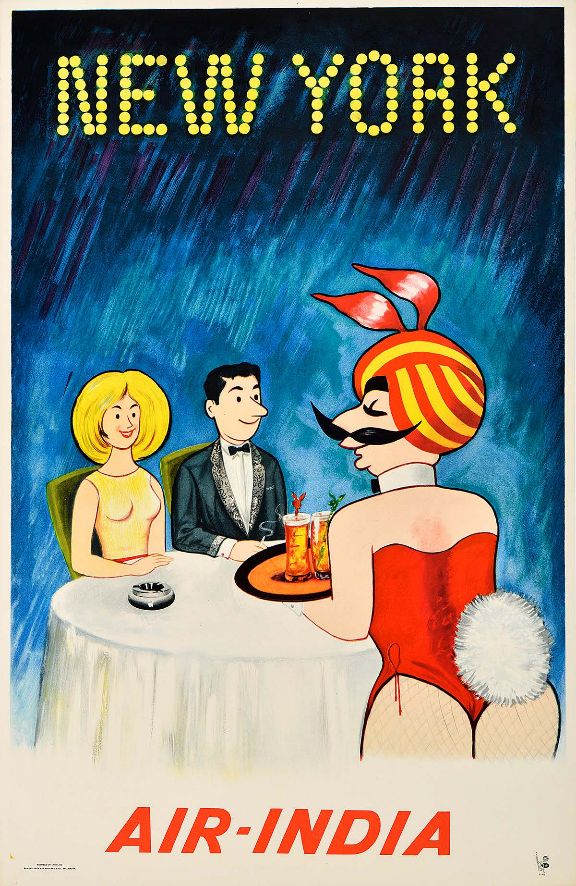
Air-India New York, S. N. Surti, 1967. The Maharaja, dressed up as a Playboy Bunny and serving drinks to Hugh Hefner in New York, is one of 191 posters catalogued in Air-India’s Rogue’s Gallery (1977). The cosmpolitan Maharaja context-switches seamlessly and is described by the airline’s publicity department as “conceived by Bobby Kooka, delivered by Umesh Rao, raised by Jal B. Cowasji, adopted by the world.”
The Indian music press, it seems, does not know whose taste it has borrowed. Taste arrives through osmosis and then solidifies into something like instinct. It’s like that moment at a dinner party when someone says something strange and you glance at your bestie or someone with the right kind of power in the room for clues about how to arrange your face.
Once a framework for evaluating music becomes invisible, it just feels natural, and this is when it feels like it is yours. I’m not suggesting that one walk through life constantly holding the genealogy of their aesthetic judgements at hand, I just want to notice how, when we stop noticing entirely where our musical standards are coming from, then our tastes, inherited through choice or circumstance just feel like our own perception.
The Sonic Passport
Return, for a moment, to 2024
Hanumankind’s Big Dawgs has just gone viral. As the rest of the world is catching on, Indian Music Diaries runs an article that notes the reaction videos exclaiming, “There’s no way this guy is Indian!” The piece doesn’t bother to spot the patronizing behaviour. There’s a gleeful paragraph on the “American accent” hitting the listeners “like a pile of bricks” and leaving them “shell shocked and pleasantly surprised.” What exactly had the world already decided an Indian rapper was going to sound like, that makes a blaccent a ‘pleasant surprise’?
The writing is mirroring the international audience’s logic so faithfully that it does not even seem to notice. And honestly, this makes sense. Hanumankind’s pitch-perfect assimilation of Southern rap was the sonic passport that landed him safely inside India’s indie hip-hop scene in the first place. His Houston upbringing supplied the marinade, and he would soak up the cadences birthed from a specific history of African American dispossession and reinvention. The themes doing the heavy lifting in his songwriting hype up the hustle, self-reliance, the underdog outsider, relentless ambition, and eventual vindication. This thematic catalog is like the greatest-hits package of mainstream American rap, fully road-tested for commercial viability. It is emotionally direct and culturally portable enough to frisbee out over borders without friction. The songs ride smooth on the genius of producers like Hyderabad-based Kalmi and Bangalorean Parimal Shais, who have each built very distinctive vehicles marrying South Indian rhythms and Carnatic textures and melodic sensibilities into trap, grime and hip-hop: the resulting soundscapes are hard to even describe, let alone name. The critique extends no curiosity to why the songs work so well.
“Distinctly Un-Indian”
Let’s talk about legitimacy, and how it is smuggled discreetly inside the art that it certifies. In 2016, indie pop duo Parekh and Singh released a music video that looked like Wes Anderson had made it. The band’s saccharine production and reflective softboi lyrics found a home inside the visual language executed with the meticulousness of a very serious child building a dollhouse, all of which lend a studied fluency to the band’s extension of the Western legacies they were pulling from – ranging from Jason Mraz, to Kings of Convenience to Woody Allen, depending on who was doing the describing.
A British label, Peacefrog Records, signed them. A Guardian profile followed, written by an India-based journalist writing for a British readership, and reads like peak self-congratulatory liberal cultural politics, but manages to do something more interesting than simple colonial condescension. It documents a genuine cultural hinge-point. Underlying the somewhat clumsy formulation that the band’s music “sounds distinctly un-Indian, as though it could have been produced in any part of the world”, is the tipping point at which a generation of Indian musicians found license to refuse “lazy Western stereotypes of what Indian music should be”. Let’s overlook for now how it slides past why Western audiences feel entitled to such stereotypical expectations in the first place. More interestingly, is sounding placeless really making anything better, then?
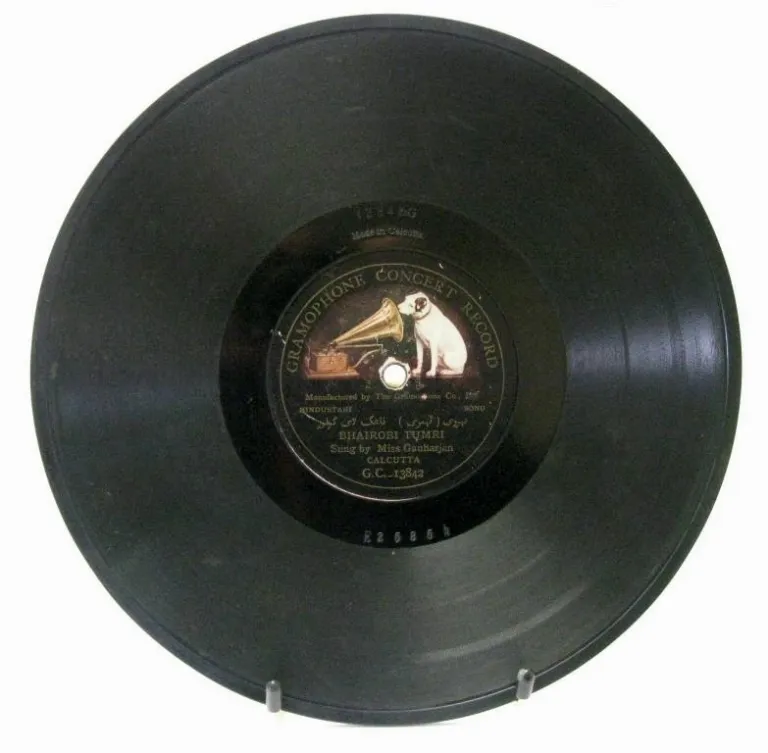
Recording of a khayal in Raag Jogiya by Gauhar Jaan, 1902. The first Indian artist to record commercially for the Gramophone Company of London — the technology arrived in India on a mission, in the company’s own words, “to record native voices.” She ended every recording with the words: “My name is Gauhar Jaan.”
If Fanon’s mimicry describes the colonised consciousness ever-split by the white world it is performing for, Homi Bhabha argued that the same-same-but-different performance of the coloniser’s grammar back with enough fidelity to be recognisable but never mistaken for the original, disrupts the white man’s claim to cultural authority. Ironically, market logic has since perverted that disruption. It now commoditizes the slight deviation from the original – as long as it doesn’t threaten real power. The Guardian profile celebrates this achievement of the not-quite-an-imitation.
In a 2019 interview, Music Unplugged reproduced the Guardian’s observation that the music “features none of the stereotypical sitars and tablas that dominate India’s music scene”, verbatim and without attribution. Somehow the whole thing has the effect of confirming, rather than dismantling the stereotypes, because the dance is happening inside the frame where Indian pop music is evaluated against the Western default and everyone keeps turning up to dance.
A Crisis of Vocabulary
The Indian music criticism scene is a small ecosystem. Publications like Rolling Stone India, The Indian Music Diaries, Wild City, and a few other independent outlets are mostly oriented towards scene documentation, artist discovery and industry development rather than deep engagement with the music and the conditions producing it. There is, in other words, little infrastructure platforming music criticism as a serious cultural object, although, in 2026, it would be inaccurate to call the Indian pop music scene itself nascent. Perhaps what’s missing is the critical vocabulary. Qualities like placelessness capture at once the yearning and dissonance of growing up in India in the nineties. If Prateek Kuhad was irked at landing in Spotify suggestions next to Arijit Singh rather than John Mayer, it is because this costs him global legibility.
Amanda Weidman, in her history of Carnatic music, Singing the Classical, Voicing the Modern: The Postcolonial Politics of Music in South India, shows that the dynamic is structural, not incidental, when Carnatic music’s claim to being ‘classical’ indigenous high culture was assembled in dialogue with colonial standards of legitimacy. The tradition presenting as purely native is already pregnant with the encounter that produced it. The ecosystem is gestating a newer kind of Indianness now, pioneered by a diaspora gaze that brings the Western legacy home. Hanumankind does not need to market his fluency in Southern rap the way that Kuhad had to shop his influences.
Now, the Western gaze is no longer outside, gatekeeping credibility. The diaspora artist’s gaze completes the cultural circuit. Hanumankind, like others, reaches back into Indian culture from presumably hard-earned Western fluency and presents fun bits that the West already recognises. The discordant underdog self-myth that contradicts his affluent ex-Goldman Sachs background and 2024 stage embrace by Prime Minister Modi slips under the radar. The unattributed cholo-masculinity aesthetic aggressively pulsing through his visuals is forceful and recognisable, and gets written about, unnamed, as the serious image of India having made it.
There is a sigh of relief we are granted somewhere in all this. “Indianness” has become interesting to write about again, if only because its market-value has gone up.
Meanwhile, the Indian music press suffers from a crisis of confidence. The critical vocabulary it deploys, at its best, mimics the international press, or uncritically peddles the narrative-packaging designed by the musicians themselves. And at its worst, it is the equivalent of what the internet calls vague-posting – watery non-claims underlined by a fear of accidentally saying something. And so these reviews end up gushing about how the album is “a journey,” and that the artist “does not disappoint,” and that the sound is, and a minute of silence for how important this proclamation is, “uniquely their own.”
The vague-posting makes sense once you understand what it is for. There is the thing made – the song, the video, the brand, the narrative – the product arrives pre-interpreted, packaged with its own talking points. Then there is the press content reviewing the product. Everyone has put out their content, everyone is satisfied. Everyone has done their job.
References:
Bhabha, Homi K. “Of Mimicry and Man: The Ambivalence of Colonial Discourse.” In The Location of Culture, 85–92. London: Routledge, 1994.
Fanon, Frantz. Black Skin, White Masks. Translated by Charles Lam Markmann. New York: Grove Press, 1967.
Weidman, Amanda J. Singing the Classical, Voicing the Modern: The Postcolonial Politics of Music in South India. Durham, NC: Duke University Press, 2006.
 SIGN IN WITH GOOGLE
