

Notes on a Gesture
Through a lost footage of Chandralekha’s reframing of Namaskar, Sanjita Majumdar explores what it means to write about a gesture that was not meant to be archived.
By Sanjita Majumder
In my practice-based research into feminist resistances captured through moving image technologies, I work with lost archival footage of the choreographer/dancer Chandralekha and her radical reframing of the gesture of Namaskar within the repertoires of classical Indian dance. Traditionally, the gesture of Namaskar represents the subjugation of the female corpus within Brahminical patriarchy, it inscribes a devotional submissiveness, as docile bodies bending before religious scripts, and divine ordinances. Chandralekha reverses the traditional Namaskar by combining it with Ashtanga yoga and other martial arts. The revised Namaskar is a Virbhadrasana (Warrior Pose) combined with Hastauttarasana (Raised Arm Backbend Pose). The use of martial traditions results in a geometry that emphasises grounding and elevation at the same time, as figures press down firmly into the earth and the spine reaches upward in a gesture of resistance. The repurposed VHS footage is one of the only recordings of Chandralekha that shows her explaining her radical feminist interventions in classical Indian dance from SPACES, an alternative dance school she set up in Chennai. How does one write about this gesture that was not meant to be archived?
In the film, haptic analogue visuals and the interplay between still and moving images draw attention to a form of gestural cinema. I approach the found footage not simply as an archival document, but as the remnant of a gesture: a composite unit of embodied movement that records a form of feminist resistance in the process of disappearing. As a film theorist and practitioner who has worked closely with this archival material, I am interested in what art writing might do that documentation cannot. How might reflection and critique hold the textures of a body in motion, the choreographed politics of refusal, and the afterlife of an act of embodied feminist resistance?
My essay therefore asks: what forms, structures, and languages might critical writing develop in order to reflect on embodied practices that resist capture by structures of power? In the context of postcolonial India, how might art writing become a praxis of world-making rather than merely descriptive or paranoid interpretation. In order to respond to these questions, I look at the political conditions that shape the production of embodied feminist performance as well as forces of resistance emerging from absence, erasures, and contingencies of the archive. Eve Kosofsky Sedgwick’s essay, “You Are So Paranoid, You Probably Think This Essay Is About You”, proposes an alternative to paranoid modes of reading that have shaped much twentieth-century critical thought through the intellectual legacies of Freud, Foucault, and Marx. Rather than privileging revelation, suspicion, and the exposure of hidden structures, Sedgwick’s notion of reparative reading attends to affect, touch, and texture as forms of knowledge that emerge through embodied encounters with an artwork.
I understand the haptic image as a visual counterpart to this reparative mode of reading. Haptic images invite audiences to engage as embodied and sensory participants rather than detached observers. They challenge ocularcentric regimes of spectatorship by foregrounding proximity, tactility, texture, and affect. In this sense, I propose that art writing as an embodied feminist practice might similarly attend to what is felt, sensed, and encountered in an artwork, rather than only to what can be revealed, decoded, or exposed. To write about embodied feminist resistance, then, is also to develop a language capable of attending to textures.
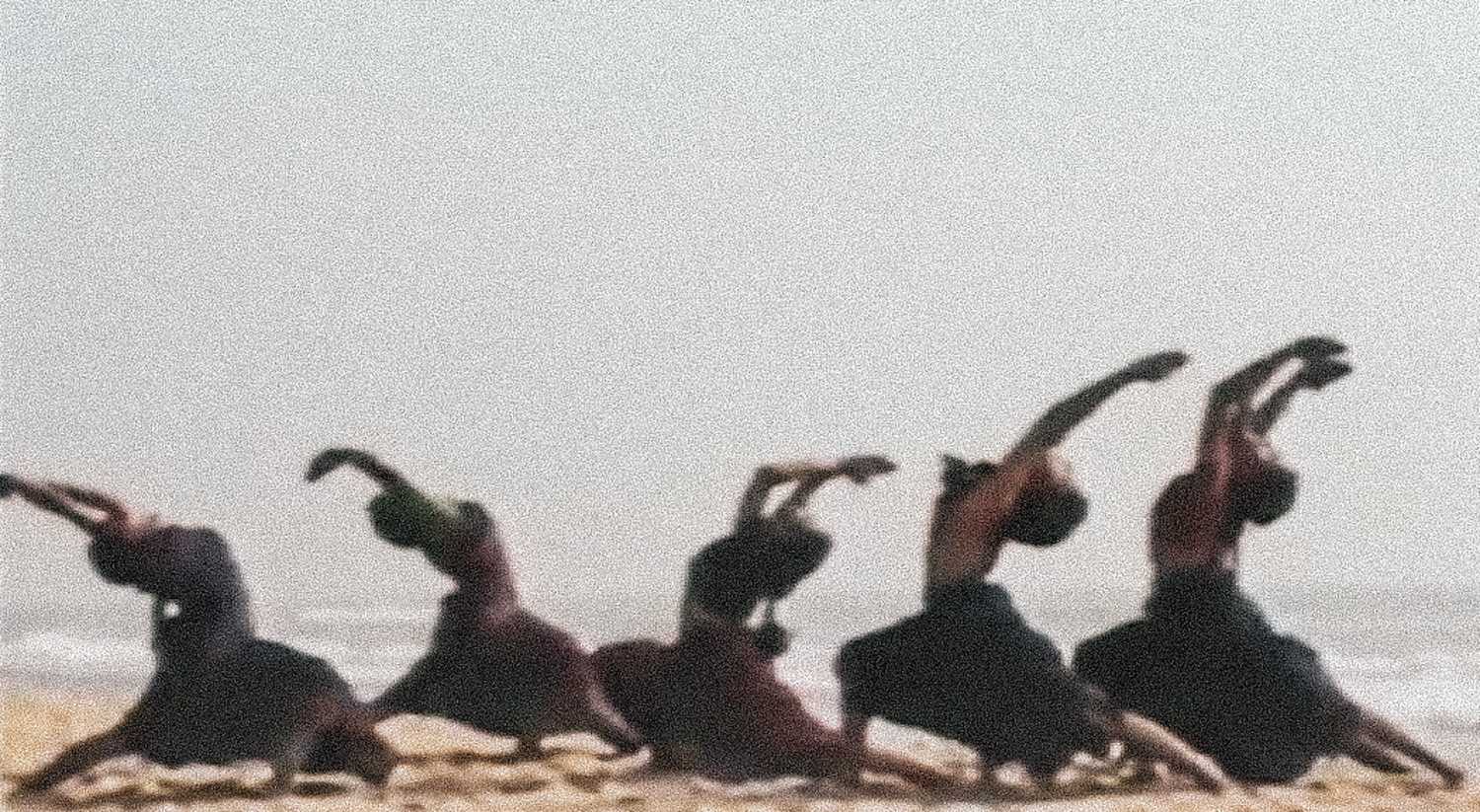
Important for any critical writing on embodied feminist practice is the question – How does the body say No; how does it refuse and resist subordination?
The VHS is one of the only recorded performances of Chandralekha that shows her everyday training routine with dancers from SPACES, an alternative dance school she set up in Chennai; it also shows her explaining her radical feminist interventions in classical Indian dance. By the 1950s, Chandralekha was already a celebrated figure in classical dance. Yet she walked away from fame, rejecting the Brahminical and nationalist ideologies that were steadily defining performance arts in postcolonial India. In the years that followed, she immersed herself in feminist organising, Marxist critical writing and political activism in India and abroad. It was this theoretical and political engagement that laid the conceptual grounds for her return to stage in 1984 with a radical feminist intervention in classical Indian dance that was unapologetically sensual and iconoclastic. As a choreographer Chandralekha went beyond challenging oppressive gender hierarchies and the existing violence against women in patriarchal societies by reframing and navigating the system from within, producing a counter-archive of embodied feminist resistances. Her choreographies and writing on performance work in tandem, they are critical as well as generative, because she does not merely critique but radically implements them through her practice.
In her essay, ‘Militant Origins of Indian Dance’, Chandralekha argues that origins of classical Indian dance can be found in labour, combat, sexuality, collective movement and the disciplined intelligence of the body. The martial and communal roots of traditional dance forms were actively erased by the Brahminical establishment that appointed itself as custodian of traditions, mobilising Sanskrit texts as an ideological tool to legitimise and reinforce gender and caste hierarchies, effectively barring marginalised communities from laying claims to a shared cultural inheritance. The concept of Lāsya-tandava, or Militancy with Grace reclaims the political agency of the female body; it recovers the roots of classical dance in collective and martial practices.. Lāsya derives from the Sanskrit word ‘las’, which means playful, graceful and to appear shining. In her work, Chandralekha yokes together feminine grace (lāsya) with the martial forms (tandava). Historically, British colonialism colluded with the Brahminical establishment to domesticate lāsya as pure devotional grace while stripping it of its martial and erotic charge, which was displaced onto the body of the devadasi. Stigmatised as illicit temple prostitutes by colonial administrators and dispossessed of their livelihood and art by the Brahminical elite, the devadasis were criminalised and banished from the social sphere, while lāsya itself was reduced to pure devotional hymns, stripped of its sensuous and erotic aspects. Repressing the erotic aspects of lāsya turns the feminine performing body into a hollow vessel onto which patriarchal-colonial ideologies of reproductive control and submission could then be inscribed.
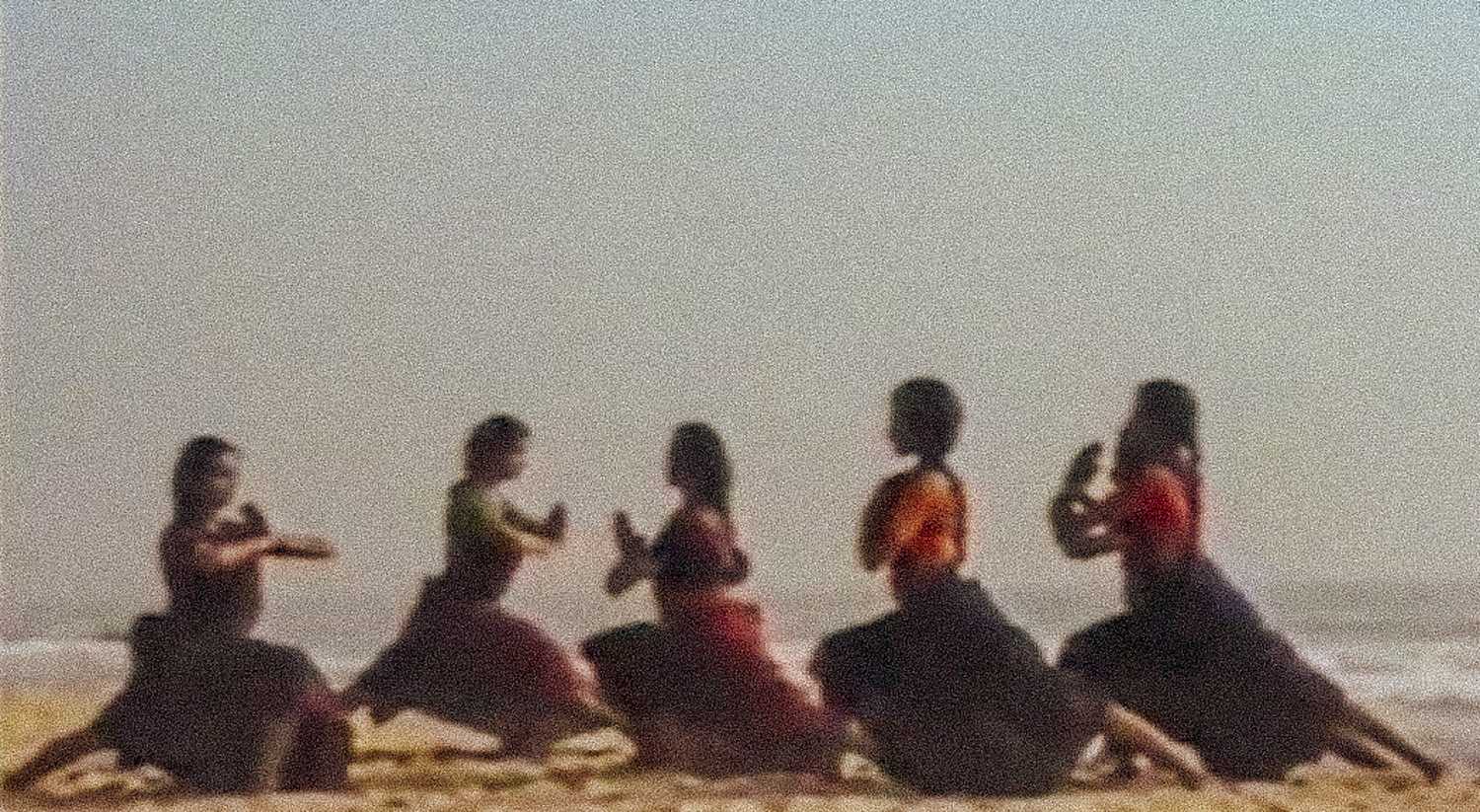
In the film, Chandralekha and the dancers practice Namaskar on Elliott’s Beach. The movements are rooted in the araimandi stance of classical Bharatnatyam dance, a basic squat position in which dancers ground themselves through the pelvis, bending deeply at the knees while focusing on the upward spine. For Chandralekha, the araimandi makes Bharatnatyam a powerful dance, and its origins can be traced back to ancient martial arts such as Kalaripayattu from Kerala and other wrestling traditions found across akharas. The bent knee grounding stance of the araimandi is foundational to martial arts as far reaching across Asia as Karate, Tai Chi and Thai boxing. She responds by extensively training dancers in the martial stance of rectitude, where the upright spine symbolises feminist ethics, political agency and the dignity of the body. The Namaskar that emerges, is far from the soft, supplicant, gentle and appeasing one found in classical Indian dance, instead it conveys a militant dignity, where the terms of the submission are clear. The embodied resistance inscribed into the Namaskar is not a confrontation or a rupture of the traditional gesture; rather it is fluid and mutable; it is refusal to comply with a patriarchal-colonial logic that demands submission. As Chandralekha explains in the film –– What is Namaskar? To me it carries the potential of the dignity of the body – what does Namaskar mean? Is it just a genuflection? that you dive at someone’s feet, you go limp? NO. To me the concept of Namaskar is that all of your body will show what is the dignity of the body.
When dealing with archival erasures of feminist resistance, writing about such art forms becomes a counter-archive. It is Chandralekha’s engagement with critical theory that adds political weight to her physical refusal, infusing it with a radical resistance through militancy with grace. Witnessing this ephemeral performative gesture in the archive creates an urgent responsibility to work with forms of language that can convey its texture and graceful dignity. Following Sedgwick’s reparative reading it may well be a desire to feel how this lost gesture offers political hope.
Work References:
Chandralekha. “Militant Origins of Indian Dance.” Social Scientist, 1980.
Sedgwick, Eve Kosofsky. Touching Feeling: Affect, Pedagogy, Performativity. Duke University Press, 2003.
 SIGN IN WITH GOOGLE
