Paradox of Distance and Writing on Art in the Contemporary Period

Does reviewing exhibitions through online media deplete art criticism or transform it?

 By Bhruvi Bhatia

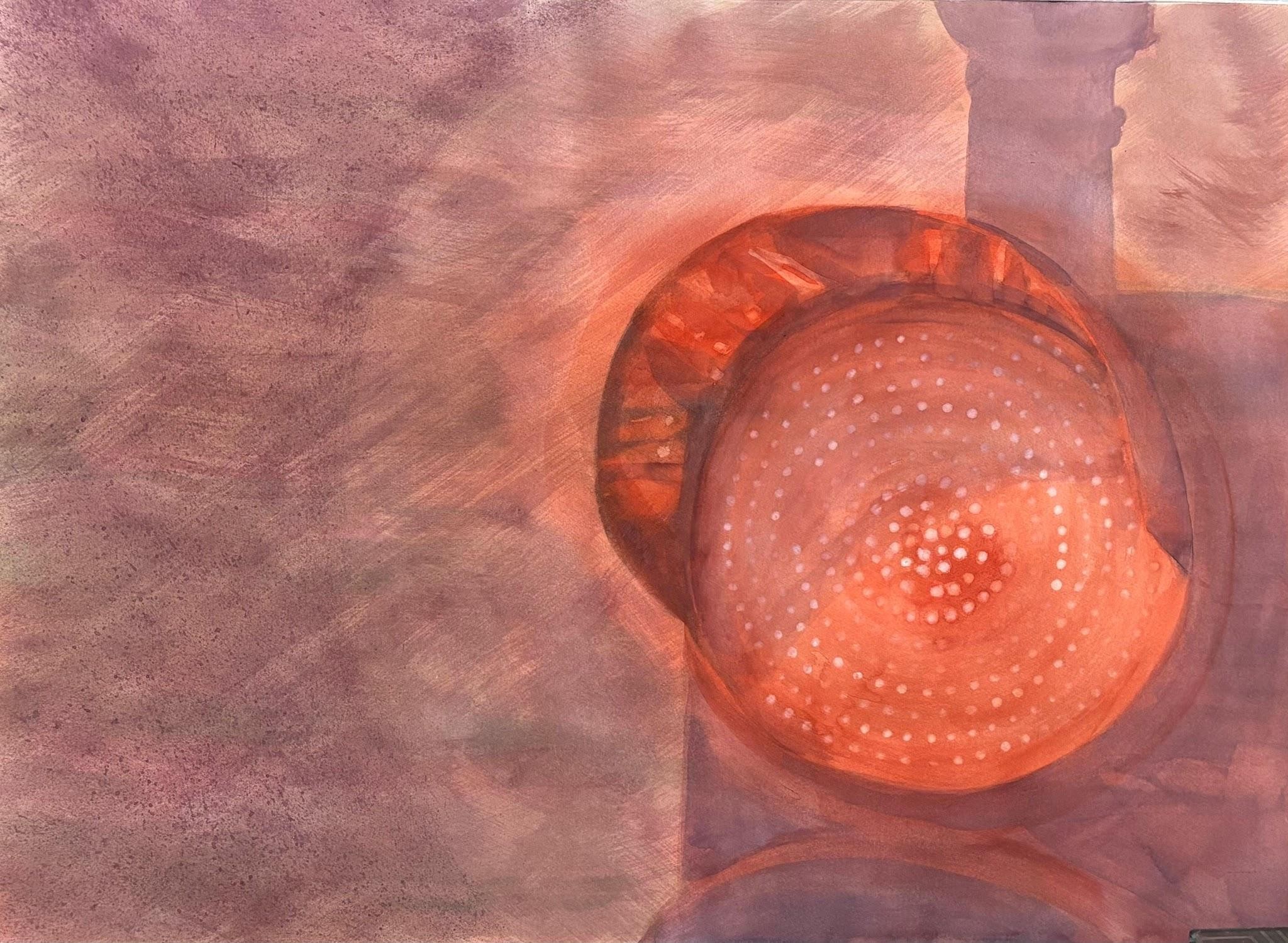
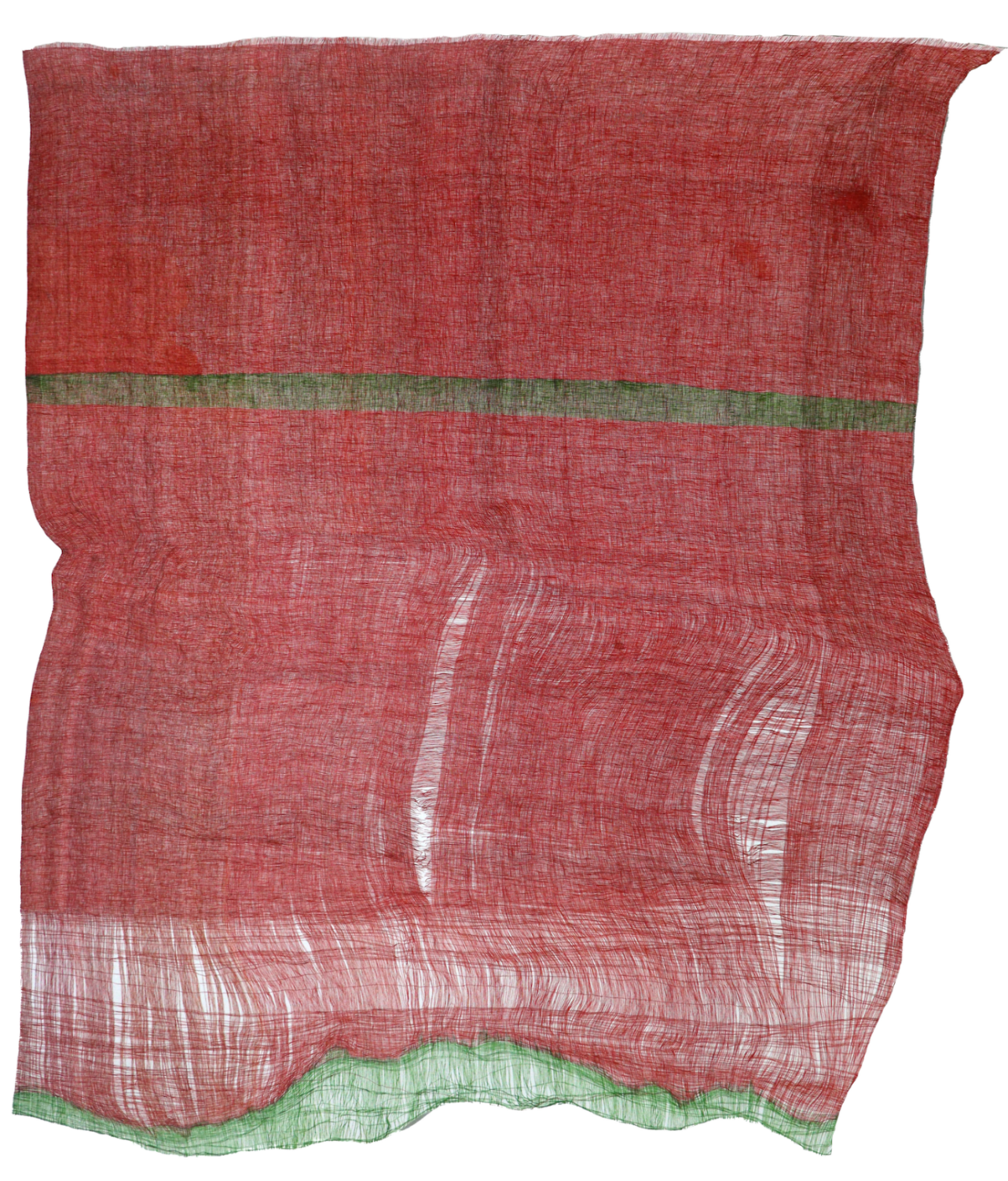
The layers of reds are stacked upon each other, wrestling until they seem to discover a place to repose. Is it the way they accumulate that lends the impression of a drain or does the familiarity of movement creates an impression of one? — I ask myself as I peer into a painting at my friend’s makeshift studio. The painting appears to be at the cusp of becoming. “It feels like an abject in the making,” I tell her, contemplating what it makes possible to feel. She with an impish grin replies that it is not a drain eager to swallow red but a red traffic light.

Chetna Soni, Untitled, 2026, Gouache on paper, 22 x 30 inches. Courtesy of the Artist.

The exchange is embarrassingly ordinary. A brief act of description dissolves the ambiguity; a title, a few words from the artist, and the artwork folds into meaning. Yet that moment foregrounds a question that has hovered over decades of art and literary criticism: what authority should be granted to the artist’s intention, and what remains the critic’s to produce? It is as quickly resolved as it emerges, deftly absorbed into familiar theoretical vocabulary. Perhaps the imagined drain is a “punctum,” an unintended detail that arrested my attention despite lying outside the artist’s intention. Or maybe it simply affirms Barthes’ well-known decentring of the author, where meaning is constituted in the encounter between text and reader rather than hinged to the point of creation.

The essay is concerned with a different, and comparatively underexamined, condition that shapes contemporary art writing: distance. Not the distance between artwork and viewer, as discussed, but the mediated, temporal, institutional, and technological distances through which artworks are now encountered, interpreted, and circulated. Before the question of what an artwork means lies another: from where, and through what conditions, does it become available in the first place? 

As a writer, I have written more than a dozen exhibition reviews for Musée Magazine, often without being physically present at the exhibition; my engagement was, instead, mediated through press kits, exhibition catalogues, and installation photographs. In an era where exhibitions increasingly privilege immersion and scale, this absence looms like a deficit. How does one write about the ephemerality of a performance or the affective charge of proximity through a flat screen?

The personal reflection coalesces into what I like to call the paradox of distance: while physical absence purports to diminished perspective, it often compels the critic to attend more intimately to textures and curatorial decisions. Since what is at stake is tridimensionality, I turn to two specific exhibitions whose very conception rest on these apprehensions. 

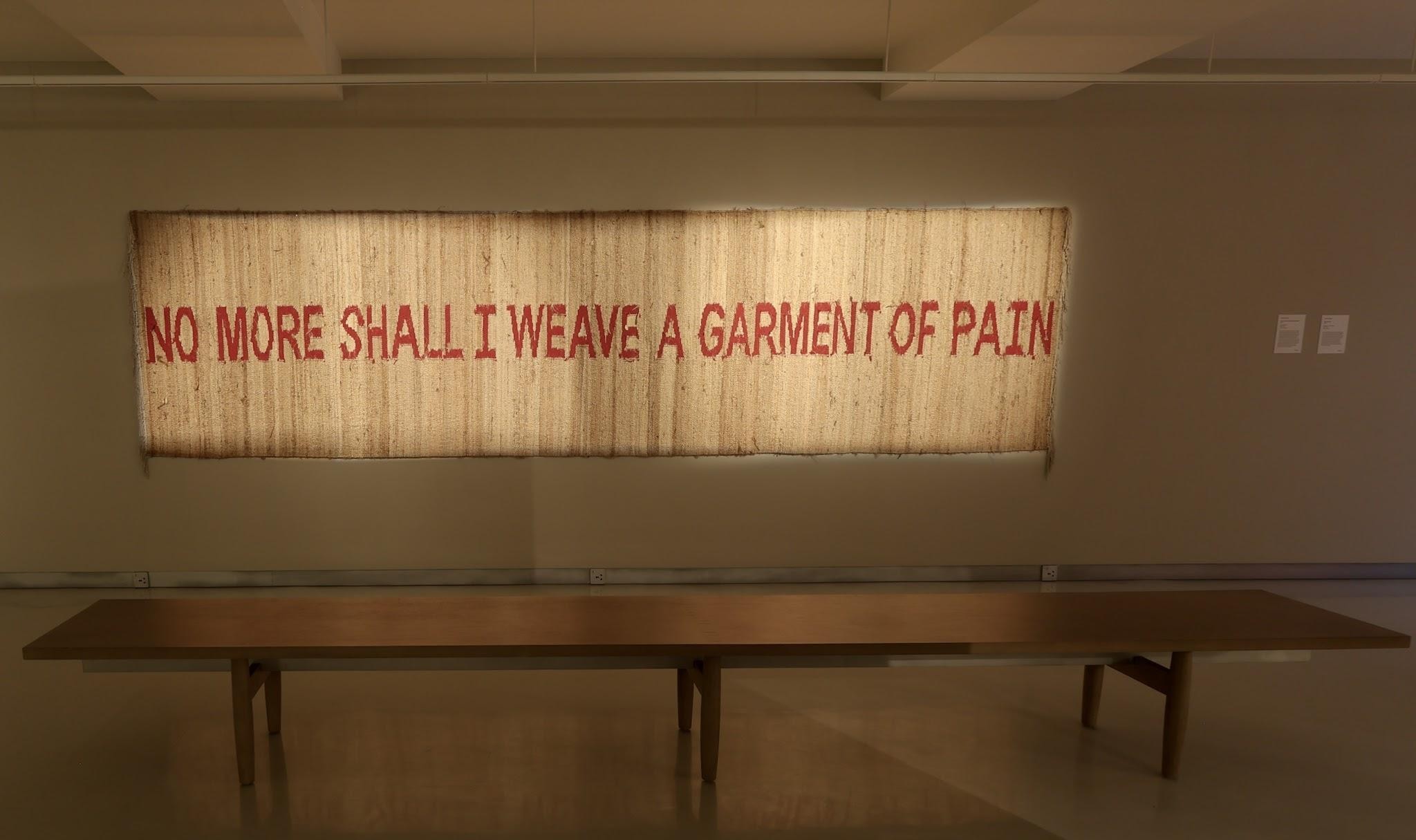
 Lived In Skin: Textile as Armour as Memory, a group exhibition presented at Latitude 28, featuring works by Sabeen Omar, Meenakshi Nihalani, and Anshu Singh, approaches textile as a repository of memory, labor, and inheritance. Fabric is treated as something lived with, carrying within its folds the traces of bodies and the weight of everyday life. On a cursory glance, the exhibition’s bent on tactility tends to resist mediation, making it a fertile site through which to test the limits, and possibilities, of writing at a distance.


Anshu Singh, No more shall I weave a garment of pain, 2023, Jute and Wool, 204 x 48 inches. Courtesy of LATITUDE 28 and the Artist.

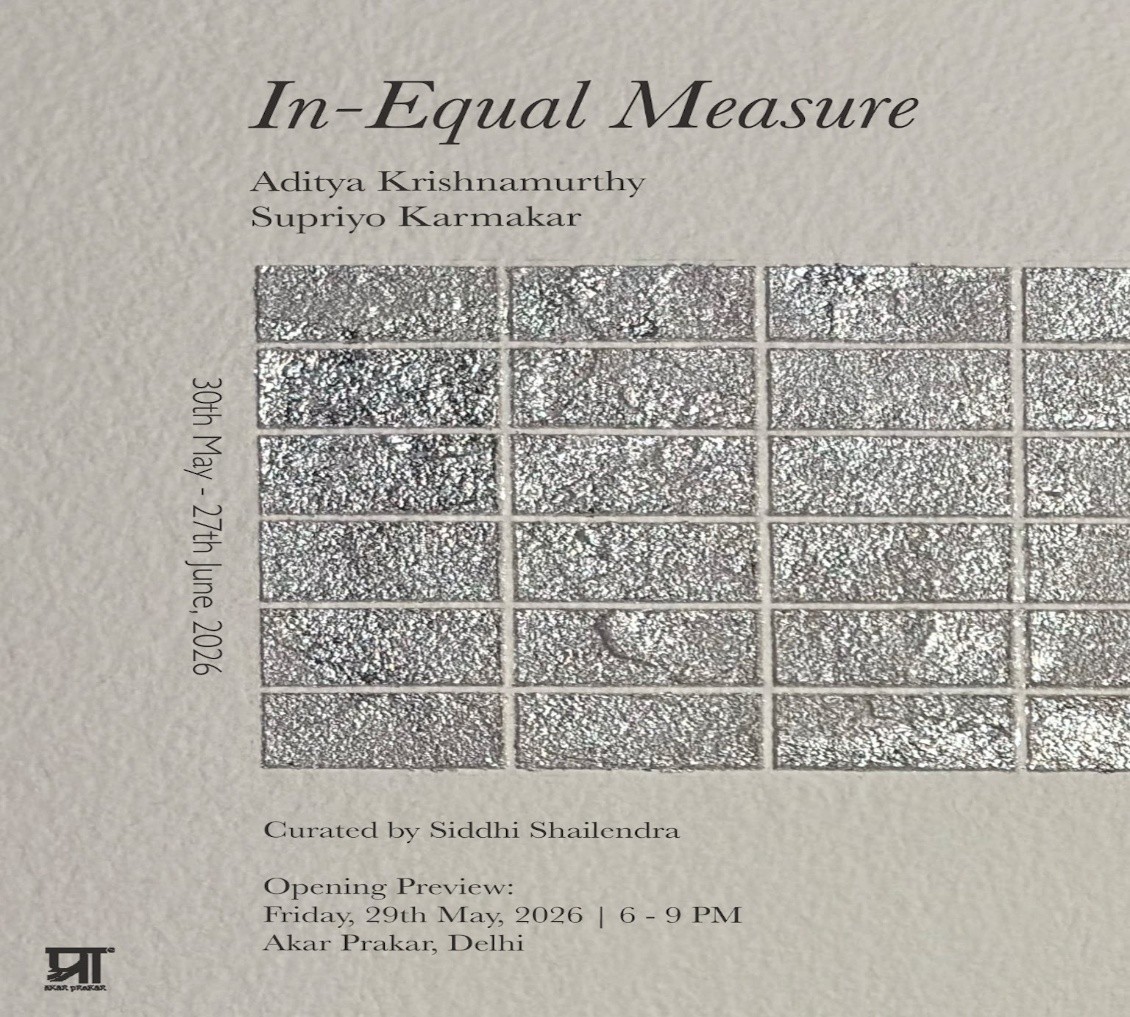
In-Equal Measure, exhibited at Akar Prakar, stages an equally demanding proposition. Bringing together the practices of Aditya Krishnamurthy and Supriyo Karmakar, the exhibition exploits line as a shared visual language. Krishnamurthy cultivates contemplative experience of time’s passage. In Karmakar’s practice, the line assumes the form of thread, where ostensibly equal units of material meld into garments, which reveal, and intensify, unequal social evaluations attached to cloth. Read

together, the works insist upon the inseparability of time and space. They stimulate the viewer to move, pause, compare, and inhabit the interval between lines.

Supriyo Karmakar, Memory Loom III, 2026, Gouache, acrylic and gold leaf on paper, 24×96 inches. Courtesy of Akar Prakar and the Artist.

The Illusion of Whole-ness

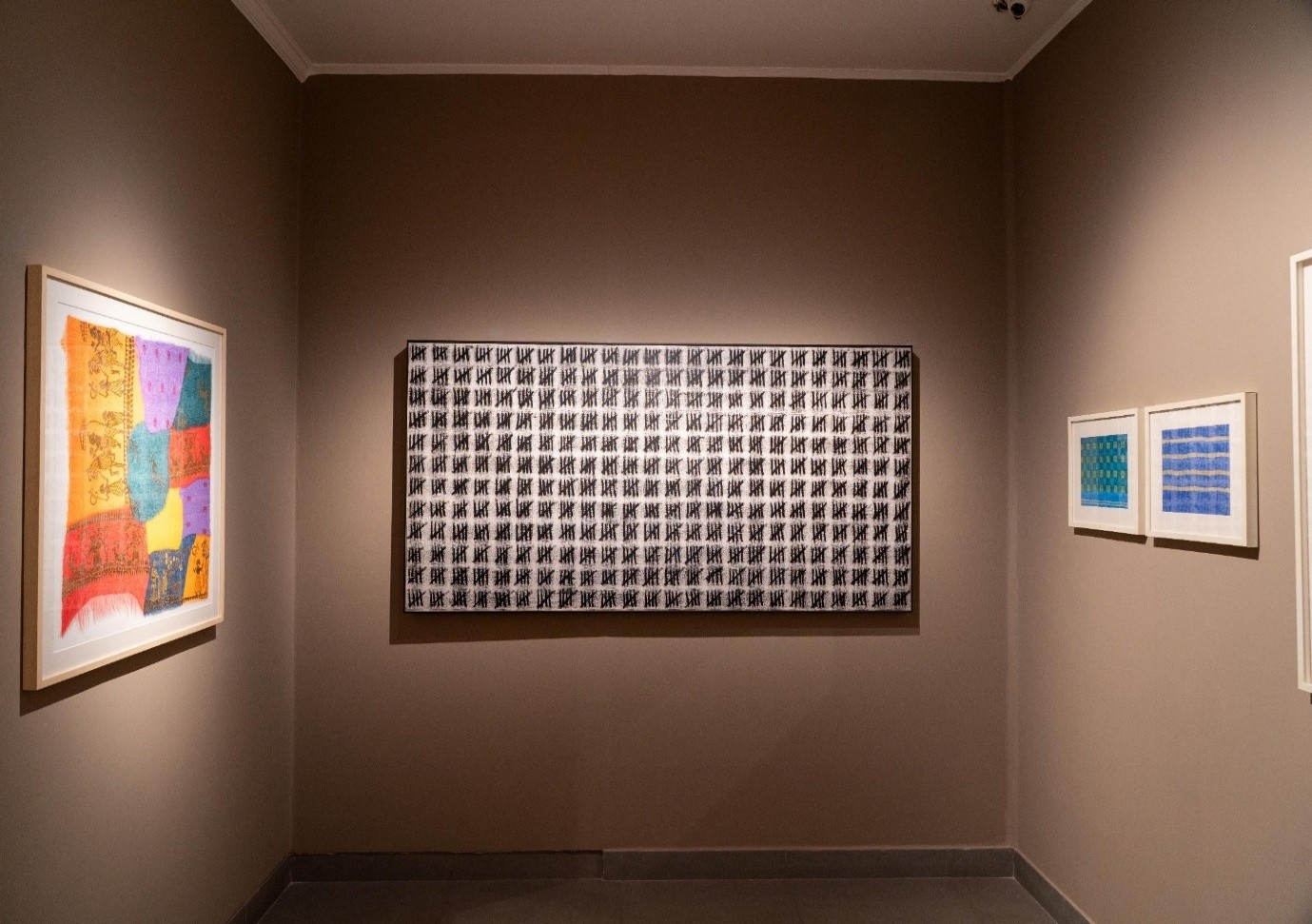
As I enter Akar Prakar, I witness a fragment of a painting. The part of it is concealed by the wall on which Karmakar’s archival prints are displayed. The painting arrives before me as incomplete, yet I instinctively register it as a whole, its partial visibility sustained by the continuity of the exhibition space. Even as I move myself closer to a new work, Keeping score no. 2, that occupies a wall of its own, my gaze refuses to be contained within its frame; other pieces linger in my peripheral vision, the light rushing through the canvas shared by them. The artwork’s meaning is constituted relationally through this illusion of whole.

Installation Shot (central wall: Keeping score no. 2, Aditya Krishnamurthy; adjacent walls: artworks by Supriyo Karmakar. Courtesy of Akar Prakar and the Artists.

A similar experience unfolds at Latitude 28. Standing before where does longing rest?, I catch my own shadow falling across the suspended textile. My reflection briefly becomes part of the work’s surface. The encounter acquires renewed significance because the work itself conceives of cloth as an intimate companion to the body. Such moments are exacting to anticipate through documentation alone. They stem from the contingencies of visiting the exhibition.

When the three-dimensionality of an exhibition is translated into separate digital reproductions of its constituent artworks, it inevitably relinquishes a mode of seeing; within the two-dimensional logic of the screen, architecture, scale, and movement no longer organise perception the same way. However, the distance does not subtract from experience. Emancipated from a network of relations and immediacy, each artwork presents itself on screen as self-sufficient, soliciting an intensity of looking seldom afforded within the gallery. If the exhibition causes an illusion of whole, the image also creates a similar fictitiousness: each artwork exists as a complete object.

To fully comprehend this illusion of whole-ness conferred by singularity of artwork on screen and the peculiar intensity of attention it yields, Laura Marks’ notion of haptic visuality becomes particularly productive. She describes a way of looking where “the eyes themselves function like organs of touch.” Although she predominantly formulates the concept through moving images, it is evenly essential for digital encounters. Rather than observing an artwork with physical detachment, the illusion of whole-ness invites an intimate proximity; the gaze settles on the grain and material resistance of the artwork, as though experiencing tactility through vision.

Marks says, “haptic looking tends to rest on the surface of its object.” Consequently, textures garner an unusual austerity. It is exemplified by my interaction with Omar’s works where I initially mistook parts of paper for textile. The physical proximity, as one would anticipate, didn’t immediately dispel confusion. If anything, digital reproductions of the same works inspired a more deliberate engagement. As I was conscious of meeting one medium through another, I returned to the exhibition catalogue and material descriptions. Thus, mediation didn’t reduce knowledge, it just transformed the epistemic process through which it was produced. 

Sabeen Omar, to be in pain is innocent (Hugh Prather), 2022, Gouache, ink, coloured pencil, graphite, paper, 21 x 10.5 inches. Courtesy of LATITUDE 28 and the Artist.

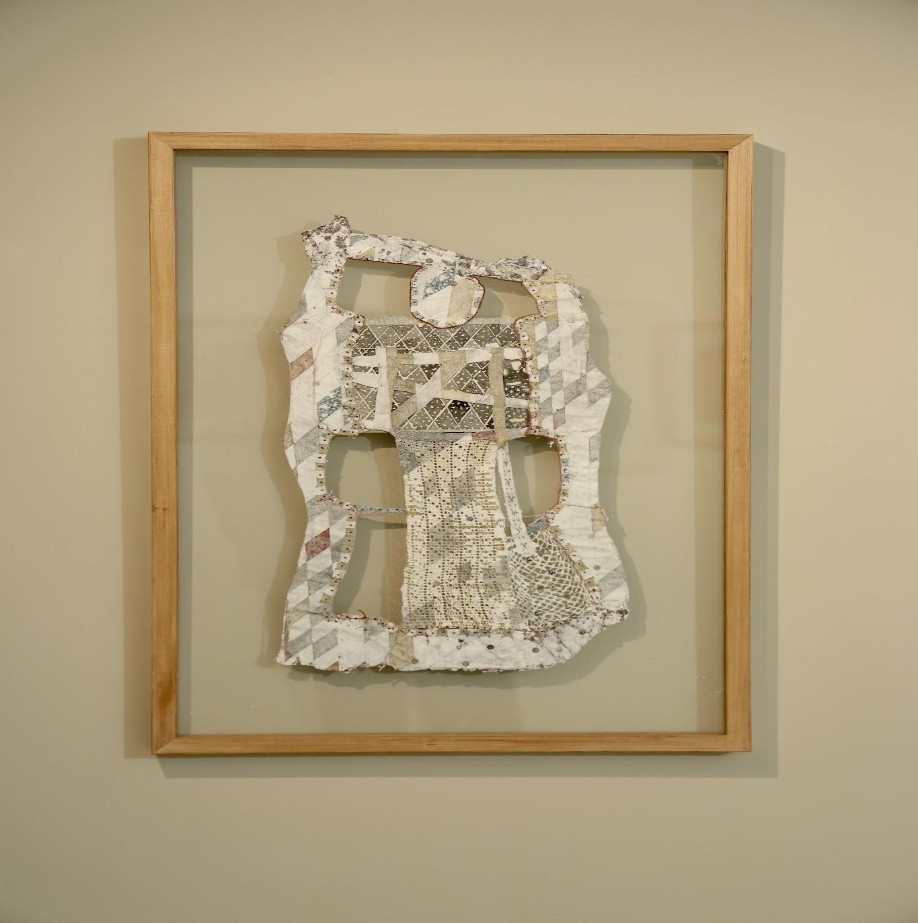
A comparable instance occurred at Akar Prakar. The Emeritus posed itself to be manufactured from cloth, only to disclose itself as a simulation of fabric. Just as the reproduction of artwork demanded that I distrust my vision and examine the image more sincerely, the exhibition itself asked the viewer to look beyond the deceptive homogeneity of threads towards the unequal histories of class woven into cloth. The act of looking through the screen became implicated in the meaning-making. My hesitation, revision, and return were no longer responses to the artwork; they came to mirror its very thematic force.

Supriyo Karmakar, The Emeritus, 2024, Watercolour on paper, 28×23.5 inches. Courtesy of Akar Prakar and the Artist.

The screen, after all, remains an image fashioned by human hands; it carries the vestiges of material labor and stretches of time even as it mediates them. As noted, the proximity the illusion of whole-ness begets, can occasionally accentuate those qualities or meanings envisioned to suffer. So, the tactility and the endurance of time which was at risk, as expressed at the onset of this section, is therefore not simply lost but differently constituted through mediation. This is the paradox of distance. As one mode of encounter recedes, another comes into being and simultaneously opens the prospect of a slower, more tactile, and distinctively attentive way of seeing.

Filling Gaps 

If distance augments ways of seeing, it also mobilises imagination as another means of interpretation, enabling the viewer to anticipate what remains beyond perception. At the kernel of the concept, lies intimacy. Unable to encounter the exhibition in person, the viewer begins to inhabit its possibilities: the route the body might take through the gallery, the shifting relations between objects, light, and movement.

The realm of possibility also offers a response to the question: what becomes of the critic’s role in an age where circulation precedes encounter? More often than not, one comes to know of the exhibition through social media announcement, a cropped image of the artwork overlaid with text, sometimes a curatorial note positioned beneath it. Signifier and signified may look momentarily fused together; meaning seems readily available. The critic’s task, then, is perhaps not to secure interpretation but to lay it open — to attend to possibilities, eventualities, and relations that remain in excess of what is instantly given.

Courtesy of Akar Prakar and the Artist

This essay has been an experiential account of that process. While a growing body of scholarship has scrutinized the differences between encountering artworks in person and through digital reproductions, less attention has been paid to viewing undertaken with the explicit intention of criticism.

References:

Barthes, Roland . Camera lucida: Reflections on photography. Translated by Richard Howard. United States: Echo Point Books & Media, LLC, 2025. 

Barthes, Roland. “The Death of the Author.” In Image, Music, Text, translated by Stephen Heath, 142–48. New York: Hill and Wang, 1977. 

Key, Laura E. B., and Brittany Pheiffer Noble. An analysis of Ferdinand de Saussure’s course in general linguistics. London: Routledge, 2017.

“Laura Marks on ‘Haptic Visuality’ and Some (Haptic?) Stills from Zidane: A 21st Century Portrait,” October 18, 2024. https://digitalcinemauoft.wordpress.com/2014/10/28/laura-marks-on-haptic-visuality-and-some-haptic-stills-from-zidane-a-21st-century-portrait/

Marks, Laura U. Skin of the film: Intercultural Cinema, Embodiment, and the senses. Duke University Press, 2000. 

Marks, L. U. “Video Haptics and Erotics.” Screen 39, no. 4 (December 1, 1998): 331–48. https://doi.org/10.1093/screen/39.4.331

Writer’s Bio:

Bhruvi Bhatia is a writer and researcher based in Delhi. She holds a Masters in English and Cultural Studies from India. She has recently received a grant from India Foundation for the Arts, and has written extensively for Musée, a visual arts magazine based in New York. Her research spans visual studies, spatial studies, and artistic and heritage practices. She has presented her work at various national and international conferences, held research positions at leading institutions and worked on projects exploring questions on decolonisation.